 EVCP Info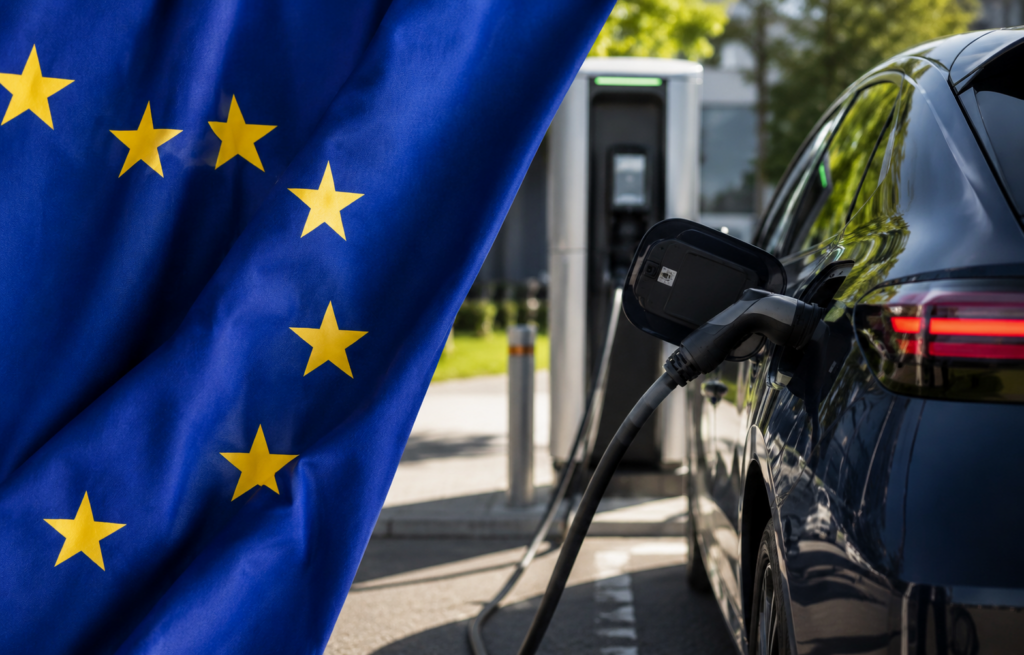
Article contents
The EU’s trajectory from its recent baseline is steep. At the end of 2023, EAFO recorded 632,423 public charging points across the EU – meaning the network has added well over 500,000 points in roughly two and a half years. The European Commission’s target of 3.5 million public charging points by 2030 implies an average of approximately 410,000 new installations per year, a pace that the current build rate is approaching but has not yet consistently sustained.
Three countries – the Netherlands, Germany and France – continue to host a disproportionate share of the EU’s charging infrastructure, accounting for around 61% of all public points despite occupying only 22% of the bloc’s land area. That concentration reflects divergent national policies, subsidy frameworks and private investment levels. Germany’s large-scale infrastructure commitment and France’s rural charging subsidies stand in contrast to the position in many central and eastern European states, where charger counts remain significantly lower but power-per-point metrics are often higher, reflecting a focus on fewer, higher-capacity installations.
The Alternative Fuels Infrastructure Regulation (AFIR) is the key regulatory driver behind the buildout. In force since 2023, it requires fast-charging pools of at least 150kW every 60km along TEN-T core corridors for light-duty vehicles, with obligations for heavy-duty corridors requiring higher power levels on similar timelines. Compliance with those corridor requirements is driving both infrastructure investment and difficult conversations about grid reinforcement, planning consent and the financing structures that can support the necessary scale of deployment.
As of the EU27 position, the charging power capacity data from EAFO’s September 2025 update showed 34.5GW of installed charging capacity – well above the 12.8GW AFIR target for that date, though with recognised risks of overrepresentation in the data. The 2030 AFIR target stands at 55.6GW, calibrated against a projected fleet of 34.3 million BEVs and 13.7 million PHEVs. Reaching that target while addressing the geographic inequalities in coverage, and while ensuring that HDV-specific infrastructure keeps pace with the electrification of commercial transport, represents one of the most complex infrastructure challenges the EU has faced in the energy transition.
Related articles
UK rapid-charging tariff spread reaches roughly 39p-93p/kWh
UK rapid and ultra-rapid public charging prices now span roughly 39p/kWh to 93p/kWh across selected tariffs in Chargenet's 11 September comparison, illustrating how difficult…
More than 90% of UK councils have public charging, but on-street gap remains
More than 90% of UK councils have at least one public EV charger within their area, but only 39% report on-street charging provision, according…
European battery-storage installations forecast to rise 78% to 57 GWh in 2026
European battery-storage installations are forecast to reach approximately 57 GWh in 2026, up from 32 GWh in 2025, according to EUPD Research's latest Electrical…