 Viktors Nikolajevs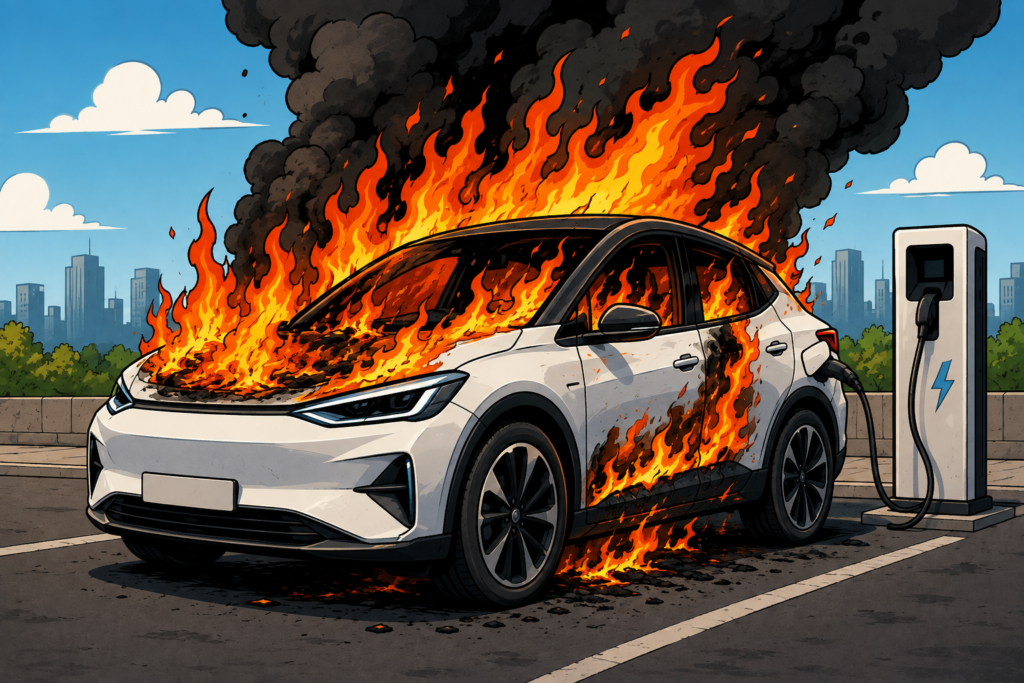
Article contents
The difference is what can happen once a high-voltage battery is involved. A battery fire may take longer to cool. It can reignite after the visible flames have gone. That matters for homes, workplaces, depots and car parks, even if the chance of a fire remains low.
The statistics also need care. The UK still has no single national dataset that consistently records the vehicle’s power type, whether it was charging, what started the fire and whether the traction battery was involved.
The short version
- UK insurance-claims data found fewer fire claims per 100,000 battery-electric cars than petrol or diesel cars.
- A battery fire can need more cooling water and longer monitoring, with a risk of reignition.
- Charging is not recorded consistently enough to calculate a reliable UK ‘fire while charging’ rate.
- UK law is mainly risk-based. It does not set one national spacing or sprinkler rule for every charging site.
- Insurers may ask for controls that go beyond the legal minimum. Their requirements should be checked before the charger location is fixed.
What do the UK figures show?
The clearest UK comparison comes from Thatcham Research, the research centre funded by UK motor insurers. Its figures appear in the government’s 2023 covered-car-park guidance, prepared by engineering consultancy Arup for the Office for Zero Emission Vehicles.
Thatcham reviewed fire claims from 2018 to 2020 and compared them with Department for Transport vehicle totals. Theft-related claims were removed to reduce the effect of arson.
The average annual rates were about 1 fire claim per 100,000 battery-electric cars, 3 per 100,000 plug-in hybrids and range-extended cars, 7 per 100,000 petrol cars and 11 per 100,000 diesel cars.
This is useful evidence, but it is not a complete record of every vehicle fire. The electric fleet was also smaller and younger during the period studied.
London provides more recent incident counts
London Fire Brigade publishes an incident-level spreadsheet for lithium-battery and electric-vehicle fires. In 2025 it recorded 91 car incidents: 20 battery-electric, 70 hybrid and one where the power type was unknown.
The spreadsheet does not contain a matching vehicle-fleet total. It also does not consistently say whether the car was charging or whether the traction battery started the fire.
Norway’s national fire-reporting system points in the same broad direction. It recorded 29 electric-car fires and 658 combustion-car fires in 2021. However, those raw counts should not be turned into a rate without matching fleet, age and exposure data.
Are EVs catching fire because they are charging?
There is not enough consistent evidence to give a reliable UK answer. Many incident records do not say whether the vehicle was plugged in, what caused the fire or whether the high-voltage battery was involved. Arup found no sound basis for calculating how charger power or charging itself changes the overall vehicle-fire rate.
That does not mean the charging equipment can be ignored. A damaged cable, loose connection, unsuitable socket, incorrect protective device or poorly maintained charger can start an electrical fire. Compliant quality equipment, competent installation and routine checks remain basic precautions.
Why battery fires need a different plan
Thermal runaway begins when heat builds inside a battery cell faster than it can escape. One failing cell can then heat the cells around it. The process may continue inside the battery pack after the visible fire has been put out.
In the tests and incidents reviewed by Arup, extinguishment took about 6 to 49 minutes where an EV battery was involved, compared with roughly five minutes for a typical combustion-vehicle fire. The review also cited about 10,000 litres of water for an EV battery incident and about 4,000 litres for a combustion-vehicle fire.
Arup also reported reignition in 13% of the vehicles in the EV FireSafe dataset available at the time. One research case reignited 22 hours later.
The US National Transportation Safety Board reached a similar practical conclusion after investigating four battery-fire incidents in 2020. It warned emergency responders about thermal runaway, reignition and energy remaining in a damaged battery. It was a case study, not a fire-frequency survey.
What does UK law require?
Fire-safety law differs across the UK. In England and Wales, the main legislation is the Regulatory Reform (Fire Safety) Order 2005 known as FSO. Scotland uses the Fire (Scotland) Act 2005 and Fire Safety (Scotland) Regulations 2006, while Northern Ireland uses the Fire and Rescue Services (Northern Ireland) Order 2006 and Fire Safety Regulations (Northern Ireland) 2010.
All three systems broadly require those responsible for non-domestic premises to assess the fire risks, provide suitable precautions and keep the assessment up to date. Adding chargers or changing the parking layout should trigger a review.
Building regulations cover building work and are devolved across the UK. Fire-safety guidance is provided by Approved Document B in England and Wales, Section 2 of the Scottish Building Standards Technical Handbooks, and Technical Booklet E in Northern Ireland.
EV charging infrastructure is covered by Approved Document S in England and Standard 7.2 in Scotland. Wales has consulted on similar requirements but has not yet introduced them, while Northern Ireland currently has no direct building-regulations equivalent.
None of the Building Regulations provide a complete EV fire-response requirements or a universal rule for charger spacing and sprinklers.
Workplace charging equipment in England, Wales and Scotland is subject to the Electricity at Work Regulations 1989. Northern Ireland has broadly equivalent requirements under the Electricity at Work Regulations (Northern Ireland) 1991. These require electrical systems to be properly constructed, maintained and worked on by competent people to prevent danger.
BS 7671 Section 722 and the IET Code of Practice provide the main technical route for EV charging design and installation.
What are insurers recommending?
Insurer guidance is not the same as legislation. Nor is every recommendation automatically a condition of cover. The policy wording, endorsements and any site-specific survey requirements are what matter for a claim.
There is also no single insurer rulebook. Published advice from Allianz, Aviva, Zurich and the insurer-backed RISCAuthority uses different distances and controls. That is a good reason to involve the property insurer before the charger position and fire strategy are settled.
Domestic installations
The publicly available insurer guidance reviewed for this article is less prescriptive for an ordinary private home than it is for commercial property. The recurring advice is straightforward:
- Check the home and motor policies before installation. Ask whether the wallbox, supply cable and charging lead are covered, whether the work must be declared and whether an approved installer is required.
- Use a properly selected wallbox on a dedicated circuit, installed and certified by a competent contractor to the current wiring rules. Do not treat an extension lead or an ordinary household socket as the normal charging solution.
- Keep the charger and cable in good condition. Check for impact damage, heat, cracked plugs, trapped cables or repeated tripping, and stop using damaged equipment.
- Keep the charging area clear of bins, stored fuel and other easily ignited material. Allianz recommends a well-ventilated, preferably open location and at least two metres from combustible materials or combustible parts of the building.
Insurance cover also varies. Aviva, for example, says some of its motor and home products cover a home wallbox, charging cable, supply wiring or surge damage. Owners should read their own schedule and exclusions.
Workplaces, depots, flats and public charging sites
Commercial property guidance goes further because one fire can interrupt a business or affect a whole building.
- Speak to the property insurer early. Aviva’s loss-prevention guide says this should happen before the risk-management strategy is fixed. Zurich also recommends early insurer involvement and notes that a survey may be required.
- Update the site and fire-risk assessments. Consider nearby buildings, glazing, stored goods, bins, escape routes, vehicle movement, flooding, security and fire-service access.
- Allow separation where the site permits it. Aviva says chargers should ideally be 10 metres from buildings, valuable assets or combustible storage. A 2023 IET technical article quoted Zurich guidance of 10 metres from combustible walls or 7.5 metres from extensive unprotected glazing. These are insurer recommendations, not UK-wide legal requirements.
- Use dedicated circuits, suitable RCD protection and a clearly labelled manual isolation point that can be reached safely. Protect chargers from vehicle impact.
- Inspect, test and maintain the installation. Aviva recommends recorded monthly site checks of externally sited chargers, cables and connections, alongside competent electrical inspection and maintenance.
- For enclosed or underground parking, consider early detection, compartmentation and automatic suppression. Zurich and RISCAuthority both treat these locations as needing closer assessment.
- Check unattended-charging conditions. Allianz warns that some policies restrict unattended battery charging and that failing to comply could affect cover.
RISCAuthority’s RC59 deserves particular attention. It was developed by UK insurers and published by the Fire Protection Association. It covers public, commercial and industrial sites, as well as residential settings such as blocks of flats, care homes and sheltered housing. It is guidance rather than law or an automatic insurance condition.
RC59 recommends locating workplace and visitor chargers outside where practical, protecting them from vehicle damage and keeping charging clear of escape routes and combustible materials. For internal or underground charging areas, it recommends automatic fire detection and strongly recommends sprinkler protection in enclosed car parks. Multi-tenanted residential car parks should generally be treated in the same way as commercial premises.
Where the UK could be clearer
UK law places responsibility on the dutyholder but does not set one national EV-specific layout. The government-commissioned Arup guidance discusses suppression, detection, structural protection, isolation, water supply, drainage and vehicle recovery, but it is interim and non-statutory.
The guidance also suggests automatic isolation for some covered or unattended car parks. The charger supply can be linked to the fire-alarm or suppression system so that power is cut following confirmed activation. This isolates the charging equipment but does not remove the energy stored in the vehicle battery.
London Fire Brigade goes further and recommends automatic suppression in open, enclosed and basement car parks, including commercial and residential car parks with EVs or chargers. That is an operational recommendation, not national law.
Overseas examples show other options. The US NFPA model standard requires sprinklers in all parking structures. Singapore sets measurable rules for emergency isolation switches. Norway relies more heavily on compliant electrical installation and proportionate assessment, while Australia has issued advisory building-code guidance.
Practical checks before a site goes live
- Confirm the insurer’s requirements before fixing the charger location.
- Use competent electrical and fire safety specialists.
- Update the fire risk assessment and emergency plan.
- Provide clear, accessible isolation and make sure staff know what it does – and what it does not do.
- Keep chargers away from combustible storage and protect them from vehicle impact.
- Inspect cables and equipment, record maintenance and take damaged units out of service.
- For covered or high-consequence sites, assess detection, suppression, smoke control, drainage and post-fire vehicle storage.
- Discuss access, water supply and recovery arrangements with the fire and rescue service.
The practical message is simple. EV fires appear to be less frequent than petrol or diesel fires in the best UK comparison available. But a battery fire can be a longer and more difficult incident. Charging sites should be planned for that difference without overstating the risk.
Resources
Reports
Regulations
Insurance
Related articles
Evolt becomes Ratio EV’s first accredited UK service and maintenance partner
Evolt Charging has become Ratio EV's first accredited UK service and maintenance partner after completing the manufacturer's training programme.

BTC POWER survey finds reliability is overtaking price in commercial charging decisions
A survey commissioned by US charger manufacturer BTC POWER suggests commercial EV charging buyers are placing greater emphasis on reliability, service and long-term operation…

Wallbox Pulsar Max UK chargers subject to overheating safety action
Certain Wallbox Pulsar Max EV chargers sold in the UK are subject to a product safety modification programme after a manufacturing defect was identified…