 EVCP Info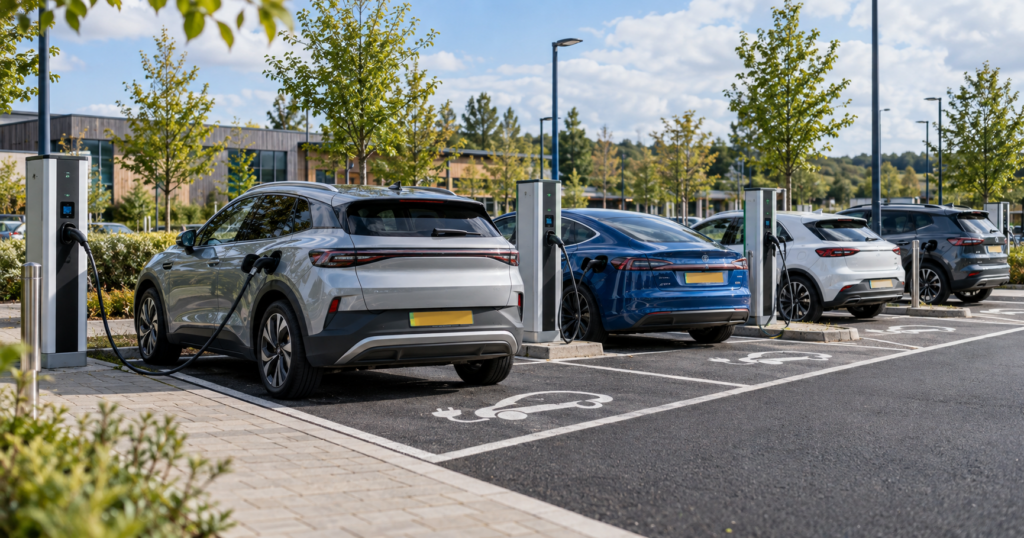
Article contents
The sites, approved at a cabinet member decision meeting on 3 September 2026, are in Berinsfield, Burford, Henley-on-Thames, Kidlington and Oxford. Seven other proposed locations across Oxford, Shrivenham, Witney and Bampton were deferred to allow further engagement or site assessment.
The council describes the programme as a £4 million government-funded initiative to install more than 1,500 public chargers by summer 2028. Earlier contract information makes clear that the wider delivery model also includes significant private investment from charge point operators, with central government investment stated at more than £3.6 million.
More than 1,500 chargers are planned by summer 2028
Connected Kerb and Oxfordshire-based EZ-Charge were appointed in June to deliver different parts of the programme. Connected Kerb is responsible for on-street chargers on the highway, Oxfordshire County Council park and ride sites and other county council car parks. EZ-Charge is responsible for charging hubs in participating district and city council car parks.
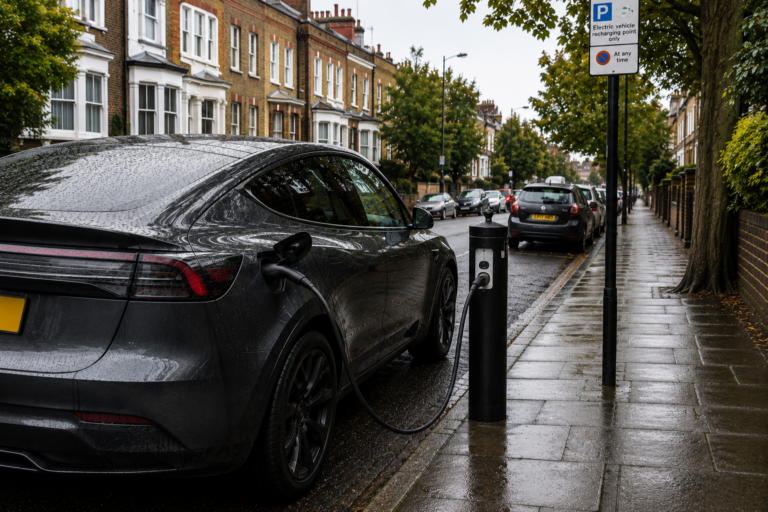
Most of the 1,500-plus chargers are expected to be installed in off-street car parks. Around 500 are planned for the public highway, primarily in areas where residents do not have access to private off-street parking.
For the on-street network, the council expects most units to be standard 7.4 kW AC chargers intended for vehicles parked for several hours or overnight. A smaller number of 50 kW-plus rapid chargers are also planned at strategic locations where the electrical supply and site conditions allow.
The programme is funded through LEVI and other government grant funding together with CPO investment. That distinction matters because the £4 million public funding figure is not the total capital value of every charger and associated installation delivered under the programme.
Seven sites were deferred after consultation
The first decision followed a formal Traffic Regulation Order consultation covering 18 proposed on-street sites between 8 July and 7 August. Oxfordshire says it received more than 700 responses.
The council considered concerns including existing parking pressure, available footway space and the visual effect of charging equipment in conservation areas. Seven sites were deferred rather than approved immediately, including proposals in Shrivenham, Witney and Bampton and one Oxford location where wider parking changes still need to be considered.
Some of the approved Oxford sites also remain subject to additional work. Hockmore Street, Water Eaton Road and Cuddesdon Way require confirmation that at least 1.5 metres of clear footway can be retained after equipment is installed. Cuddesdon Way is also dependent on whether an alternative off-street location can be delivered instead.
The Phelps site in Kidlington was approved subject to the council being unable to identify a better-supported alternative local site. Installation at all approved locations remains subject to detailed design, technical feasibility and electrical connection work.
The constraint is increasingly the street, not just the charger
The deferred locations are a useful illustration of what large LEVI programmes encounter once high-level deployment targets become specific bays, pavements and streets. A charging location can be technically useful while still creating a conflict with parking demand, pedestrian space, local access or the appearance of the streetscape.
Those trade-offs are particularly visible for near-home charging. Low-power on-street infrastructure is intended to serve residents who cannot install a private charger, but the same residents may also depend heavily on limited kerbside parking. Reserving bays for charging therefore changes how existing road space is used.
The Oxfordshire decisions also show why headline charger counts only describe part of a rollout. Each site still has to pass consultation, highway design, accessibility, electrical connection and practical installation checks before the planned network exists on the ground.
Related articles

Somerset resets £3.78m LEVI rollout after charging market changes
Somerset Council is preparing to restart procurement for its £3.78 million Local Electric Vehicle Infrastructure (LEVI) programme after reviewing the original delivery model following…
Warwickshire awards LEVI charging contracts to Connected Kerb and EZO
Warwickshire County Council has awarded major EV charging contracts to Connected Kerb and EZO as part of a joint LEVI procurement with Leicestershire, Rutland…

More than 90% of UK councils have public charging, but on-street gap remains
More than 90% of UK councils have at least one public EV charger within their area, but only 39% report on-street charging provision, according…