 EVCP Info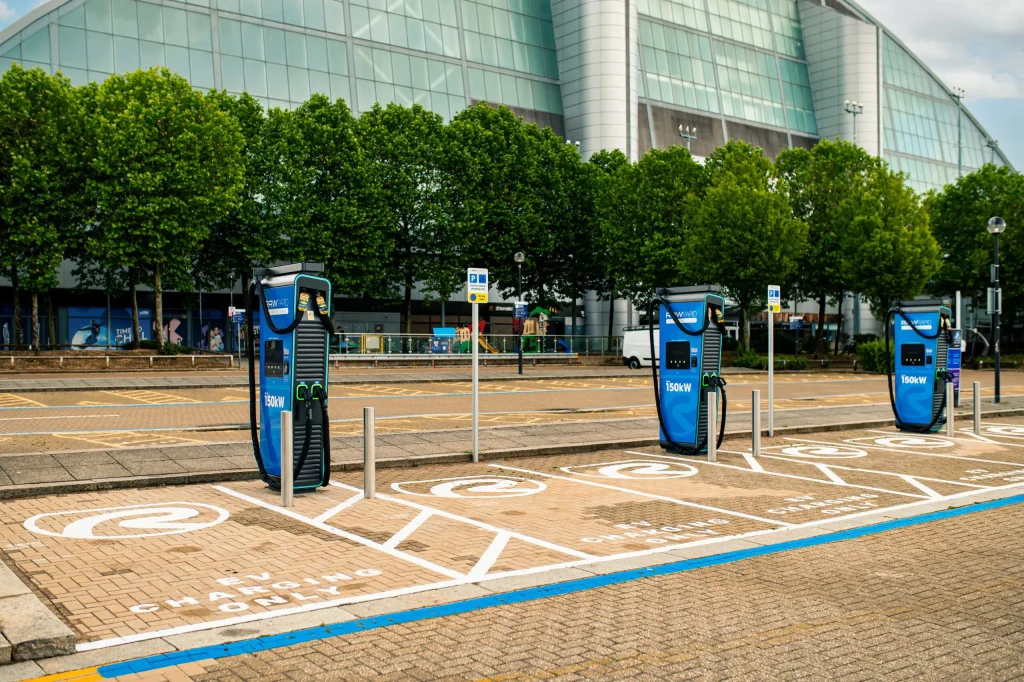
Article contents
The recent projects use a mix of AC, rapid and ultra-rapid charging rather than applying the same power rating to every bay, reflecting the different lengths of time drivers are likely to spend at each destination.
The installations provide another practical example of destination charging being designed around how a site is actually used rather than simply maximising charger power.
Three charging tiers at Xscape Milton Keynes
Xscape Milton Keynes now provides 32 EV charging bays through its partnership with RAW Charging. The site lists 16 x 22 kW destination charging bays, eight x 50 kW rapid bays and eight x 150 kW ultra-rapid bays.
That mix gives drivers different options depending on the length of their visit. Someone staying for several hours can use a 22 kW bay, while shorter visits can be supported by the higher-power DC chargers.
The Xscape installation forms part of RAW Charging’s wider partnership with property company Landsec. The existing programme involves £24.5 million of investment and targets more than 1,000 charging bays at 28 retail and leisure destinations across the UK.
National Trust sites use AC and DC around visitor dwell time
RAW Charging has also installed new charging infrastructure at Castle Drogo, Parke and Lydford Gorge in Devon as part of its work with the National Trust.
At Parke and Lydford Gorge, the recently reported layout includes two 50 kW DC charging bays and two 22 kW AC chargers at each site. The DC chargers are intended for shorter visits, while the AC units are better aligned with drivers staying for longer periods.
Castle Drogo has also received a new charging hub, with eight charging bays located close to the visitor centre and accessible parking.
Power selection should follow the use case
These sites illustrate why destination charging does not always benefit from installing the highest available charger rating at every parking space.
Higher-power DC charging can increase turnover where drivers need a shorter stop, but many destination users will leave their vehicle parked for several hours regardless of how quickly it reaches its charging limit. In those bays, lower-power infrastructure may provide enough energy while allowing available electrical capacity and project budget to support more charging spaces.
The important design question is therefore not simply how much power a charger can provide, but how the expected dwell time, vehicle turnover and available site capacity fit together.
As larger destination charging programmes continue to roll out, mixed-power sites are likely to remain a useful way of balancing convenience, charger utilisation and electrical infrastructure requirements.
Related articles

Zest to bring ultra-rapid EV charging to nine Heart of England Co-op stores
Zest and Heart of England Co-op have agreed a rollout of ultra-rapid EV charging across nine stores in the Midlands.
UK rapid-charging tariff spread reaches roughly 39p-93p/kWh
UK rapid and ultra-rapid public charging prices now span roughly 39p/kWh to 93p/kWh across selected tariffs in Chargenet's 11 September comparison, illustrating how difficult…
More than 90% of UK councils have public charging, but on-street gap remains
More than 90% of UK councils have at least one public EV charger within their area, but only 39% report on-street charging provision, according…