 EVCP Info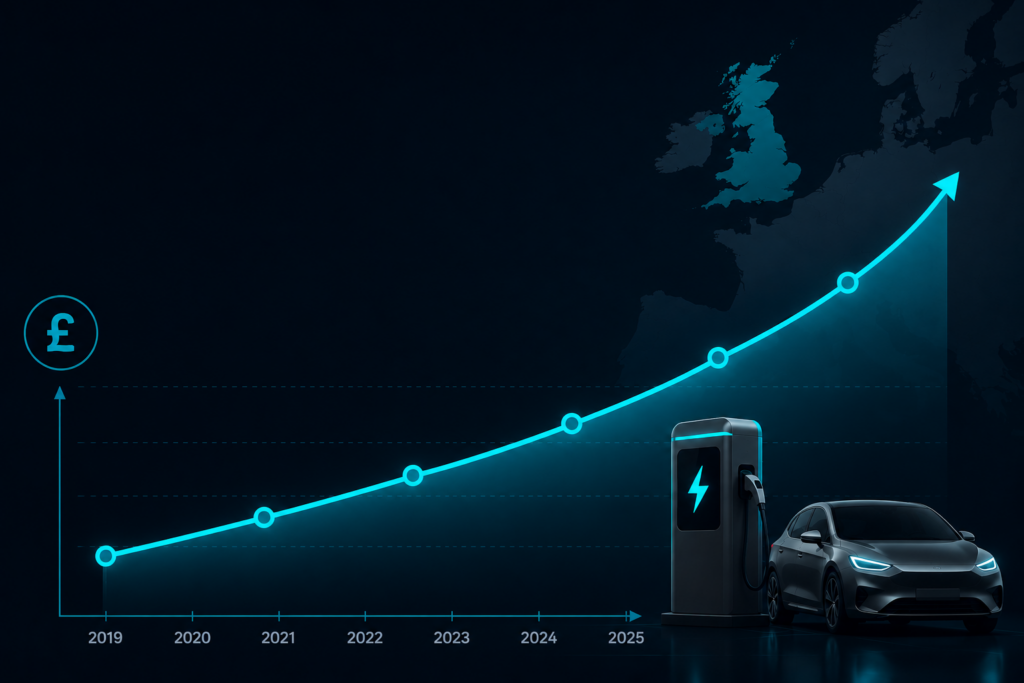
Article contents
Zapmap’s July 2026 Charging Price Index puts the weighted-average pay-as-you-go price at 54p/kWh for public chargers rated from 3 kW to 49 kW and 80p/kWh for chargers rated at 50 kW and above. Using Zapmap’s standard efficiency assumption, those figures equate to approximately 16p and 24p per mile respectively.
Rapid-network prices still vary widely
Zapmap’s separate comparison of the ten largest rapid and ultra-rapid networks shows standard PAYG prices ranging from 59p/kWh to 92p/kWh in July. Those ten networks account for around 64% of UK rapid and ultra-rapid chargers.
Promotions, subscriptions and off-peak pricing can reduce what individual drivers actually pay, so the advertised PAYG rate should not be treated as the price of every session.
The access gap is also a cost gap
Zapmap notes that the domestic energy price cap is around 25p/kWh, while dedicated off-peak EV tariffs can be much lower. Drivers with a driveway and home charger can therefore obtain energy at a substantially lower price than someone who depends on public charging.
That difference matters because lack of off-street parking is not a choice for many households. Two drivers with similar vehicles and mileage can face very different running costs simply because one can charge at home and the other cannot.
LEVI can improve access without automatically solving price
The Local Electric Vehicle Infrastructure programme is intended to expand local charging for residents without off-street parking. Increasing the supply of convenient lower-power charging should improve access and competition, but infrastructure availability and energy price are separate issues.
A new on-street charger can solve the physical access problem while still leaving the driver paying more per kWh than a household using a domestic tariff.
Charging economics include more than electricity
Public charging prices also reflect costs that do not exist in the same form at home: land, grid connections, equipment finance, maintenance, payment processing, network operation and business rates can all feed into the retail price.
The useful policy question is therefore not simply why public charging is expensive. It is whether infrastructure, taxation and energy policy together are reducing or reinforcing the cost disadvantage faced by drivers without private charging.
Related articles
US public DC fast charging cost averages published by DCFC Tracker
The average non-member price for public DC fast charging in the United States is currently $0.545 per kWh, according to DCFC Tracker's latest market…
UK rapid-charging tariff spread reaches roughly 39p-93p/kWh
UK rapid and ultra-rapid public charging prices now span roughly 39p/kWh to 93p/kWh across selected tariffs in Chargenet's 11 September comparison, illustrating how difficult…
More than 90% of UK councils have public charging, but on-street gap remains
More than 90% of UK councils have at least one public EV charger within their area, but only 39% report on-street charging provision, according…