 EVCP Info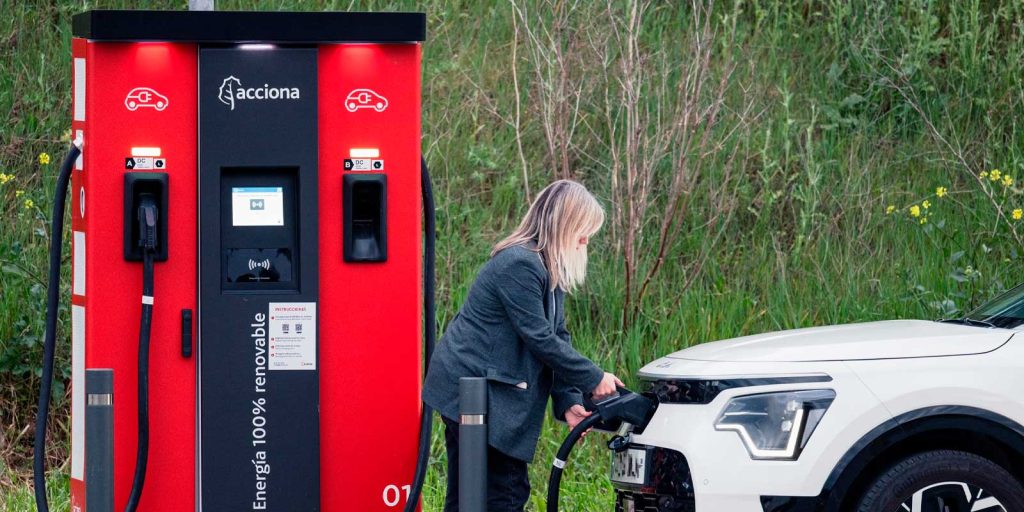
Article contents
The installation has 2 MW of contracted power and combines three charging levels to suit different types of visit. Four 240 kW chargers serve eight bays, ten 80 kW chargers cover 20 bays, and seven 22 kW units serve the remaining 14.
The charging equipment was supplied by Spanish manufacturer Circutor. Drivers can start and manage charging sessions through the ACCIONA Recarga app, while ad hoc charging is also available without registration, including direct card payment.
Three power tiers for different dwell times
The most notable feature of the site is not simply its size, but the way charging power has been distributed across the 42 bays.
| Charger rating | Chargers | Bays served | Intended stay |
|---|---|---|---|
| 240 kW | 4 | 8 | Short visits; stated charging time below 15 minutes where supported by the vehicle |
| 80 kW | 10 | 20 | Typical shopping visit; stated charging time of around 30 to 60 minutes |
| 22 kW | 7 | 14 | Longer stays; stated charging time of around two to four hours |
The 80 kW chargers account for almost half of the available bays, making them the largest part of the installation. That appears well suited to a retail location, where vehicles are likely to remain parked for longer than they would at a motorway charging hub, but not necessarily for several hours.
Matching charger power to the location
Charging sites are often judged by their highest available output, but that figure does not always reflect how useful the site will be in practice. At a shopping centre, the amount of time drivers are likely to remain parked is just as important.
A driver making a short stop may benefit from one of the 240 kW chargers, provided the vehicle can accept that level of power. Someone visiting several shops, having a meal or spending longer at the centre may gain little from using the fastest charger throughout the visit.
The 80 kW and 22 kW bays provide alternatives that are better matched to those longer stays.
A mixed-power layout may also allow the available electrical capacity to be spread across more charging bays. Instead of concentrating most of the site’s power into a smaller number of high-output units, the installation can support a broader range of vehicles and visit patterns.
For this type of destination, the decision to make 80 kW charging the dominant tier may prove more useful than simply installing the highest available output at every bay.
Related articles
Zest to bring ultra-rapid EV charging to nine Heart of England Co-op stores
Zest and Heart of England Co-op have agreed a rollout of ultra-rapid EV charging across nine stores in the Midlands.
IONITY opens first London urban charging hub with 12 400 kW bays
IONITY has opened its first charging hub inside London, with 12 ultra-rapid bays at Greenwich Shopping Park offering charging at up to 400 kW.
Tunbridge Wells installs eight 11 kW Believ chargers at John Street Car Park
Tunbridge Wells Borough Council has installed eight 11 kW public EV charge points at John Street Car Park in the St John's area of…