 EVCP Info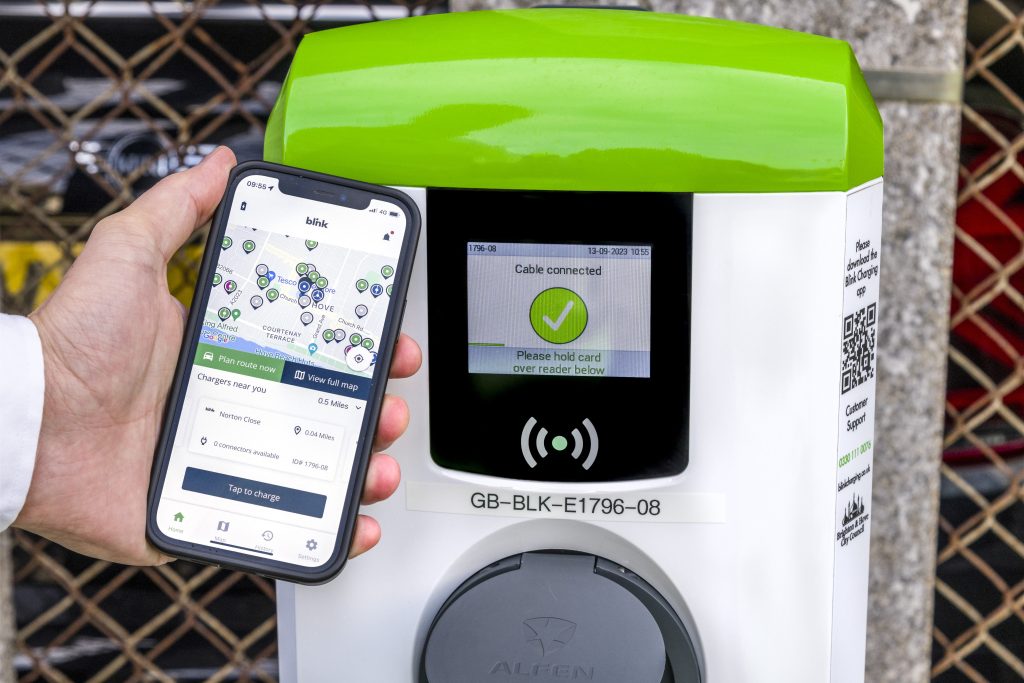
Article contents
The US-based charging company reported second-quarter revenue of $21.7 million, down 24.5% from $28.7 million a year earlier. Product revenue fell 48.7% year on year to $7.4 million, while service revenue increased 6.2% to $11.5 million and represented 53% of total revenue.
Blink has reduced its 2026 revenue guidance from $105 million-$115 million to $83 million-$90 million. At the same time, the company says it is working towards a longer-term objective of generating around 80% of revenue from recurring or repeatable sources.
Hardware sales become a smaller part of the mix
Blink defines its service revenue as repeatable charging revenue and recurring network fees. The company is also expanding into energy-management services and says these areas are intended to provide a more predictable base than relying primarily on equipment sales.
The shift is relevant beyond Blink itself. EV charging businesses can generate income in several ways: selling hardware, operating charge points, charging network or software fees, providing maintenance, managing energy, financing equipment or entering long-term concession and site agreements.
Those models create different commercial incentives. A supplier whose income depends on long-term network and service revenue may place more value on keeping customers within its software, maintenance and operating ecosystem than a manufacturer focused mainly on the initial equipment sale.
Improved margins, but lower revenue
Blink reported a gross margin of 38.9% for the quarter, up from 16.8% a year earlier. Operating expenses fell 57% to $14.7 million and the quarterly net loss narrowed from $29.3 million to $6.0 million.
Those improvements do not change the fact that revenue remains materially below the previous year and that management has cut its full-year forecast. Blink describes the change as part of a deliberate focus on what it calls higher-quality revenue, but that is the company’s interpretation of its strategy rather than independent evidence that the transition has already succeeded.
For the wider charging sector, the more useful point is the direction of travel: revenue increasingly comes from the years after a charger is installed, not just from the equipment delivered on day one.
What this means for charging infrastructure buyers
For CPOs, fleets, property owners and other infrastructure buyers, the commercial model behind a charging platform can be as important as the initial hardware price.
Recurring network, maintenance and energy-management services can simplify operation and give suppliers a reason to support equipment over the long term. They can also create dependency if access to key functions, data, roaming, diagnostics or charger management is closely tied to one provider.
That makes questions around backend interoperability, data access, contract length, service pricing, hardware ownership and the ability to move to another platform increasingly important during procurement. As more suppliers seek recurring income, the total commercial relationship over the life of a charging site becomes a more useful comparison than hardware purchase price alone.
Related articles
Jolt Capital and Tesi acquire VEV from Vitol
Commercial fleet-electrification company VEV has moved into new ownership, with Jolt Capital and Finnish state-owned investor Tesi acquiring the business from Vitol alongside VEV…
Wigan launches £110m EV charging concession for council car parks
Wigan Council has opened procurement for a long-term electric vehicle charging concession covering council-owned car parks across the borough. The selected partner will be…

Nuvve revenue rises in Q2, but V2G specialist remains financially fragile
Nuvve reported higher second-quarter revenue and a narrower loss in 2026, but the V2G specialist continues to operate with very limited cash and weak…