 EVCP Info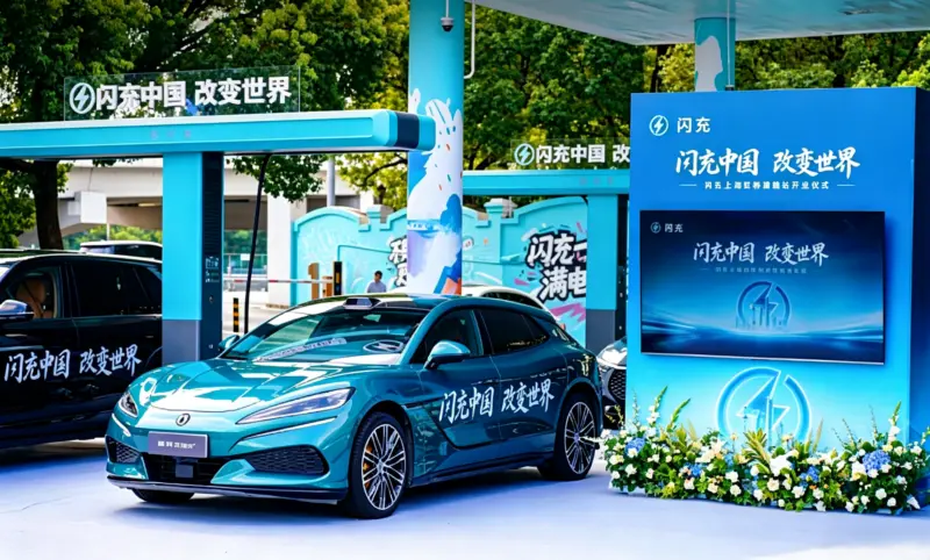
Article contents
The milestone site opened in Shenzhen on 28 August. BYD had 5,000 Flash Charging stations in operation on 1 April and is targeting 20,000 by the end of 2026.
A network built around 1.5 MW charging
BYD’s latest Flash Charging hardware is advertised at up to 1,500 kW through a single connector. The company says compatible vehicles using its second-generation Blade Battery can charge from 10% to 97% in nine minutes under favourable conditions.
Those charging-time figures are manufacturer claims and should not be treated as independently established performance across the wider vehicle fleet.
The 1.5 MW rating also creates a very different infrastructure requirement from conventional rapid charging. Liquid-cooled cables, high-current DC equipment, power-module density, transformer and switchgear capacity, thermal management and site-level power availability all become more significant as charger power rises.
BYD is building more than charger hardware
The rollout combines BYD’s vehicle platform, battery technology, charging hardware and charging-network deployment under the same manufacturer-led ecosystem.
The company is also working with energy-site partners in China to accelerate deployment and says the stations will be open to vehicles from other manufacturers. Actual charging power will still depend on what each vehicle can accept.
The expansion pace is unusually high
Reaching 20,000 stations by the end of the year would require another 10,000 sites to be added from late August onward, equivalent to roughly 80 stations per day on average.
BYD has also indicated that Flash Charging will expand internationally. Initial UK installations are being deployed, with the company previously stating an ambition for around 300 UK sites by year-end.
If that rollout continues, the more important question will be how often 1.5 MW capability is actually available at site level rather than simply the maximum rating of an individual charging output.
Related articles
BTC POWER and Summit outline 17-site US charging pipeline
BTC POWER and Summit Charging have outlined a 17-site US charging pipeline covering 107 chargers and 135 charging ports, including projects that the companies…
MFG opens eight-bay 150 kW charging hub at Kilmarnock
Motor Fuel Group has opened an eight-bay ultra-rapid EV charging hub at its Riccarton Road forecourt in Kilmarnock.
UK rapid-charging tariff spread reaches roughly 39p-93p/kWh
UK rapid and ultra-rapid public charging prices now span roughly 39p/kWh to 93p/kWh across selected tariffs in Chargenet's 11 September comparison, illustrating how difficult…