 EVCP Info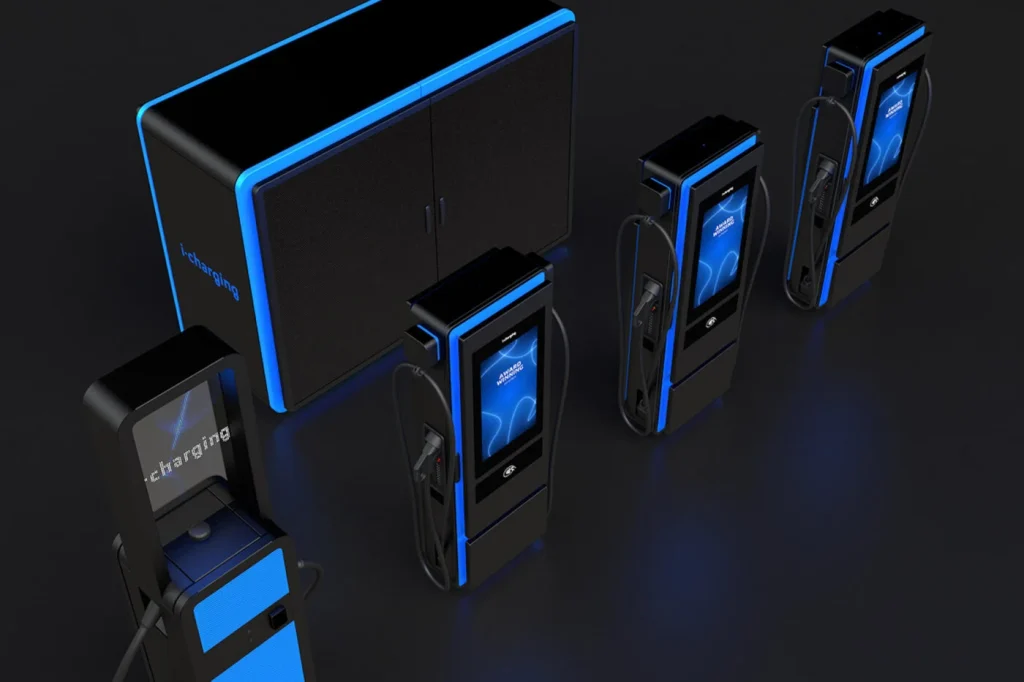
Article contents
The system provides up to 1.6 MW of centralised DC charging capacity and can distribute that power dynamically across as many as eight connected vehicles. The first commercial units left production at the end of June and use power modules supplied by SOLUM.
MAX is aimed at applications including public charging hubs, fleet depots and logistics sites, where several vehicles may need high-power charging from a shared electrical supply.
A 1.6 MW system, not necessarily a 1.6 MW charge session
The distinction between system capacity and individual connector power is important. The 1.6 MW figure describes the total power available within the MAX architecture rather than guaranteeing that every connected vehicle, or even a single vehicle, will receive 1.6 MW.
i-charging says the available power is allocated dynamically in 50 kW steps according to the real-time demand of connected vehicles. Up to eight vehicles can charge simultaneously, but their combined demand remains subject to the available system capacity.
Individual output capability also depends on the interface being used. i-charging lists CCS configurations at up to 800 kW per output and MCS at up to 1.5 MW per output in mixed CCS/MCS configurations. In practice, the power delivered at any moment will depend on the vehicle, connector configuration and what the other active outputs are drawing.
CCS and MCS can share the same platform
The MAX architecture supports CCS, NACS, GB/T and MCS, and i-charging states that different charging standards can be run simultaneously from the same system.
That makes the platform particularly relevant to sites expecting a mix of light- and heavy-duty vehicles. A depot could, for example, combine CCS charging for vans or smaller commercial vehicles with MCS infrastructure for electric trucks without building completely separate power systems.
The modular approach also allows MCS capability to be added later, which could be useful where heavy-duty charging demand is expected to grow over time.
Shared power changes how high-power charging is specified
Centralised systems such as MAX make a single headline kW rating less useful as a description of the charging site. For designers and specifiers, the relationship between total site capacity, output ratings and simultaneous vehicle demand becomes more important than the rating of an individual dispenser.
A site with 1.6 MW available across several outputs could potentially serve a larger number of vehicles more efficiently than an arrangement where each charger is designed around a fixed maximum allocation that is rarely used.
The practical questions therefore move towards how many vehicles will charge at the same time, what each vehicle is capable of accepting, how quickly the system can reallocate unused capacity and how the design accommodates a changing mix of CCS and MCS demand.
Commercial delivery of MAX is an early example of the wider move towards charging infrastructure being designed as a shared power system rather than a collection of independent chargers.
Related articles
Zerova brings 1.44 MW MCS dispenser to Europe
Zerova has introduced its megawatt-class MCS fleet satellite dispenser to the European market at IAA Transportation 2026 in Hanover, specifying up to 1,440 kW…
ENGIE Vianeo plans four German electric-truck hubs with 1 MW MCS
ENGIE Vianeo has announced four new public charging parks for electric heavy-duty vehicles at German motorway service areas, with three of the sites combining…

Electreon introduces 11 kW above-ground wireless EV charger
Electreon has introduced Lite DOT, an above-ground stationary wireless charging system for electric passenger cars and light commercial vehicles, at IAA Transportation 2026 in…