 EVCP Info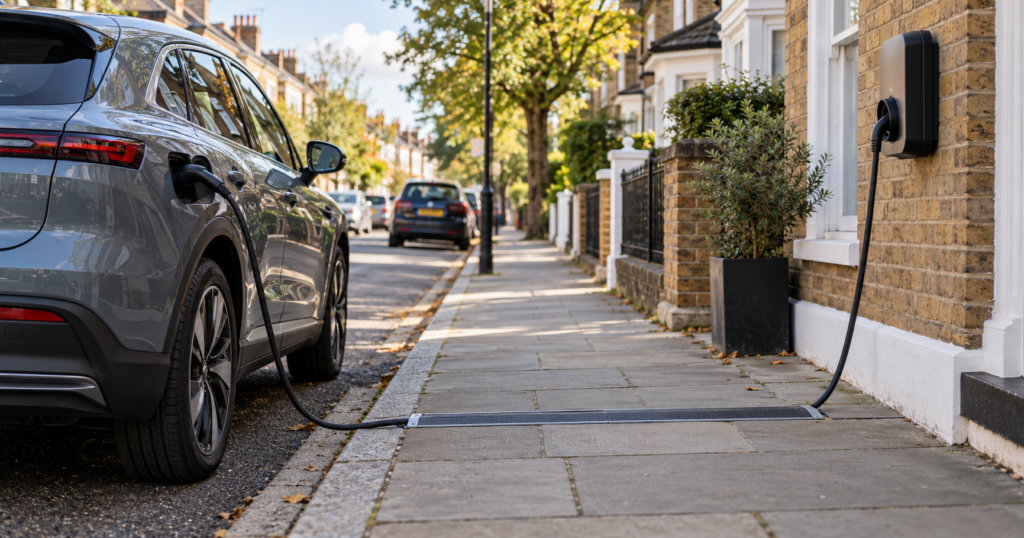
Article contents
The Economic Development and Infrastructure Services Committee approved the approach on 8 September. Residents will need council permission and a Section 109 Agreement, and the council says the applicant will be responsible for installing, maintaining and eventually removing the infrastructure.
The £923 charge is a highway approval cost, not the installation price
Moray will charge £923 for the Section 109 process. The council says this includes the Roads Opening Permit for the minor works and is intended to recover its costs for application processing, the legal agreement and site inspections.
That fee sits alongside the physical charging installation. A resident may still need to fund the home charge point, electrical work, the cross-pavement channel and any site-specific civil work. The resulting project cost can therefore be materially higher than a conventional driveway charger even before the £923 council charge is considered.
The council says eligible residents may be able to access the Scottish Government-backed Cross-Pavement Charging Grant. Energy Saving Trust currently advertises support of up to £3,500, subject to local-authority permission. At the time of writing, however, its live list of authorities accepting grant-linked applications had not yet been updated to include Moray, so applicants should not assume funding is immediately available until the scheme administrator confirms this.
Moray places ongoing responsibility with the resident
The ownership and liability structure is one of the most important parts of the policy. Moray is permitting private apparatus beneath the public footway through the Section 109 mechanism, while placing installation, maintenance and removal responsibility on the resident or service provider rather than taking those functions into council ownership.
That differs from some emerging English models. Tameside, for example, has approved an initial cross-pavement scheme where successful residents are expected to pay £600 and the fee is reported to cover council maintenance of the channel for ten years. The comparison shows that ‘cross-pavement charging’ is not a single delivery model: highway ownership, maintenance responsibility, resident fees and the treatment of the installation when occupancy changes can vary materially between authorities.
A third branch of residential charging is taking shape
For households without a driveway, residential charging has traditionally meant relying on public infrastructure. Cross-pavement systems create another option: private electricity and a private charge point can be used while the cable crosses the adopted highway through an approved, flush or otherwise protected route rather than lying loose across the footway.
In Scotland, local roads authorities retain responsibility for permitting private apparatus in the road, and Transport Scotland has confirmed that Section 109 of the New Roads and Street Works Act 1991 provides the relevant permitting power. This means the practical offer to residents can differ by council even where national grant support is available.
Moray has committed to reviewing the policy after one year. The details worth watching are how many applications are approved, the total installed cost to residents, how inspections and maintenance work in practice, and whether the council publishes clearer rules for parking availability and changes of property occupancy.
Related articles
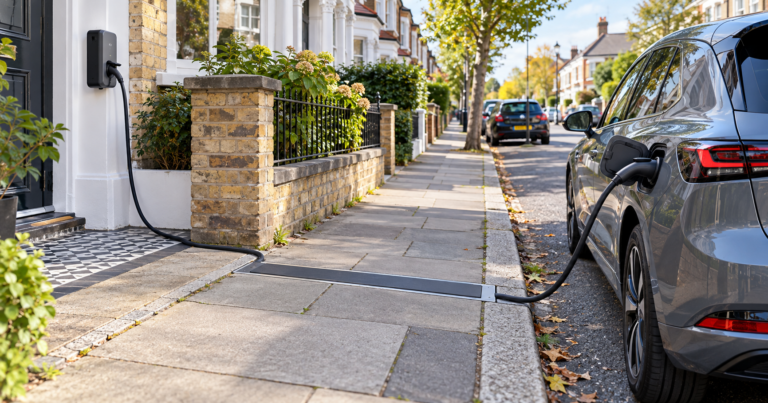
Tameside approves £600 cross-pavement EV charging trial as live guidance lags
Tameside Council has approved a cross-pavement EV charging policy for residents without off-street parking, with an initial trial of approximately 150 installations expected to…

Electreon introduces 11 kW above-ground wireless EV charger
Electreon has introduced Lite DOT, an above-ground stationary wireless charging system for electric passenger cars and light commercial vehicles, at IAA Transportation 2026 in…
Pod offers EVA England members home charger subscription
Pod has become EVA England's first home-charging partner, offering members a choice between a discounted charger purchase and a subscription-based home charging package.