 EVCP Info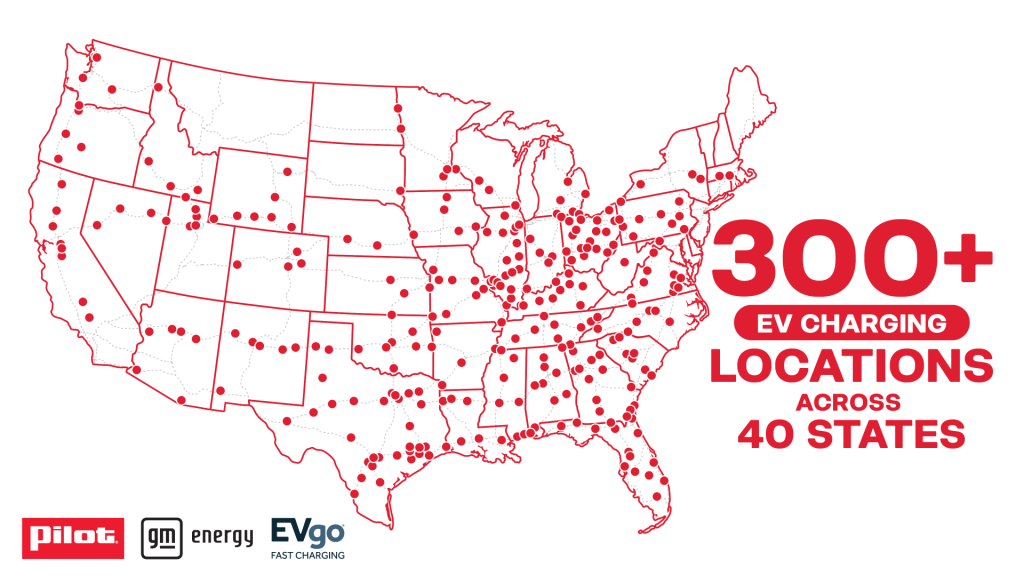
Article contents
EVgo says the programme now includes more than 1,300 fast-charging stalls across 40 states. The network was announced in 2022 and is now more than halfway towards its target of up to 2,000 charging stalls at as many as 500 locations.
The companies say the current network spans approximately 75% of the contiguous United States by land area.
A charging model built around existing travel centres
Rather than creating a completely new network of standalone charging sites, the programme places fast charging at Pilot and Flying J travel centres. These locations already serve long-distance road users and typically provide facilities such as toilets, food, Wi-Fi and staffed 24-hour operation.
Several of the charging sites also include canopies and pull-through charging stalls. That is particularly relevant as larger EVs, vehicles towing trailers and commercial vehicles become a greater part of public charging demand.
For the charging industry, the significance is not simply the number of sites. The model brings together an established travel-centre operator, an automotive manufacturer and a charging-network operator, with each contributing to a deployment programme that can be repeated across a large property portfolio.
Standardised deployment can simplify expansion
Large multi-site partnerships can make it easier to develop repeatable approaches to site design, customer facilities, operation and maintenance. They can also give the charging operator access to locations that already have high vehicle throughput and established roadside visibility.
That makes the US programme relevant to the UK despite the different market and regulatory environment. Similar questions are emerging around the role of fuel retailers, motorway and roadside businesses, CPO-funded sites and financing models for independent forecourts.
Recent UK examples include Allego’s proposed expansion through commercial host partnerships and Kempower’s first UK project funded through its leasing arrangement with DLL. The commercial structures differ, but all point towards charging being integrated into existing roadside businesses rather than treated as a separate property category.
Geographic coverage should not be confused with network density
EVgo’s 75% figure is useful for showing how widely the programme has spread geographically, but it should not be interpreted as meaning that 75% of US drivers have a site nearby or that three quarters of road journeys are covered at a particular spacing.
For corridor charging, the more useful measures are often site spacing along key routes, number of operational stalls, peak-time availability, vehicle access and the consistency of the customer experience.
Even with that distinction, passing 300 locations shows the scale that a standardised forecourt and travel-centre model can reach when property, vehicle and charging-network partners are aligned.
Related articles
MFG opens eight-bay 150 kW charging hub at Kilmarnock
Motor Fuel Group has opened an eight-bay ultra-rapid EV charging hub at its Riccarton Road forecourt in Kilmarnock.
UK rapid-charging tariff spread reaches roughly 39p-93p/kWh
UK rapid and ultra-rapid public charging prices now span roughly 39p/kWh to 93p/kWh across selected tariffs in Chargenet's 11 September comparison, illustrating how difficult…
More than 90% of UK councils have public charging, but on-street gap remains
More than 90% of UK councils have at least one public EV charger within their area, but only 39% report on-street charging provision, according…