 EVCP Info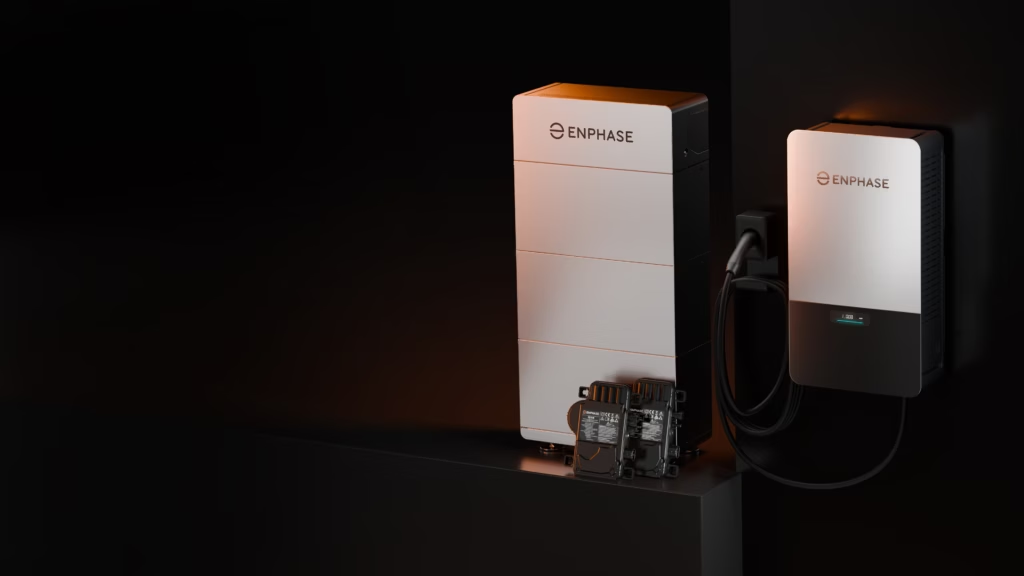
Article contents
The launch brings the IQ System Controller 3 together with the IQ Battery 5P and IQ EV Charger 2, with system configuration and monitoring handled through the Enphase platform.
EV charging becomes part of the wider home-energy system
The IQ EV Charger 2 can operate as a standalone charger or as part of an Enphase solar and battery installation.
When integrated with the wider system, Enphase says the charger can adjust charging in response to available surplus solar, beginning from around 1.4 kW of surplus generation. Homes using third-party solar can add a compatible consumption meter to enable the same solar-charging function.
The European IQ EV Charger 2 supports up to 22 kW on three-phase supplies and 7.4 kW on single phase. Enphase also lists OCPP 2.0.1 and API support for external integrations.
The important change is system-level control
The launch reflects a wider change in domestic charging. The charger is increasingly one controllable load within a home that may also contain solar PV, a battery, heat pump, flexible tariff and import or export limits.
That makes the energy-management architecture more important. Instead of the charger independently deciding when to use solar, the wider system can coordinate generation, storage and vehicle charging from the same platform.
Integration brings benefits and trade-offs
A single ecosystem can simplify commissioning and give the homeowner one place to manage energy flows. It can also increase reliance on the same manufacturer for hardware, software and future system expansion.
Enphase partly reduces that dependency by allowing the IQ EV Charger 2 to operate independently and by supporting external integrations. The practical value of the full system will still depend on the property, tariff, solar generation, storage capacity and how the household wants to prioritise its available energy.
Related articles
European battery-storage installations forecast to rise 78% to 57 GWh in 2026
European battery-storage installations are forecast to reach approximately 57 GWh in 2026, up from 32 GWh in 2025, according to EUPD Research's latest Electrical…
240 MW Chessington battery project clears EIA screening stage
Kingston Council has determined that a proposed 240 MW battery energy storage project at Chessington does not require a full Environmental Impact Assessment at…
Loughborough starts solar-canopy EV charging hub with battery storage
Work has started on a £200,000 solar-canopy, battery-storage and EV charging project at Southfield Road Extension Car Park in Loughborough, with completion expected in…