 EVCP Info
Article contents
The consultation, published on 14 August, runs until 23 October 2026 and covers the Vehicle Emissions Trading Schemes Order. Parts 1 to 4 are being conducted jointly with the Scottish Government, Welsh Government and Northern Ireland Department for Infrastructure.
What the ZEV mandate actually does
The ZEV mandate came into force in January 2024. It sets an annual target for the proportion of each manufacturer’s new car and van registrations that must be zero emission.
The current headline target for cars is 33% in 2026, rising to 38% in 2027, 52% in 2028, 66% in 2029 and 80% in 2030. For vans, the equivalent targets are 24%, 34%, 46%, 58% and 70%.
These headline percentages are not the same as a simple national BEV sales quota. Manufacturers can use mechanisms including trading, banking, borrowing and transfers between the ZEV and CO2 schemes to meet their obligations. That means actual BEV market share can sit below the headline target while manufacturers remain compliant.
Four 2030 target pathways are being considered
For cars, three of the four illustrative pathways reduce the 2030 headline target from the current 80%. The fourth retains the existing trajectory but extends key compliance flexibilities. Equivalent options are proposed for vans.
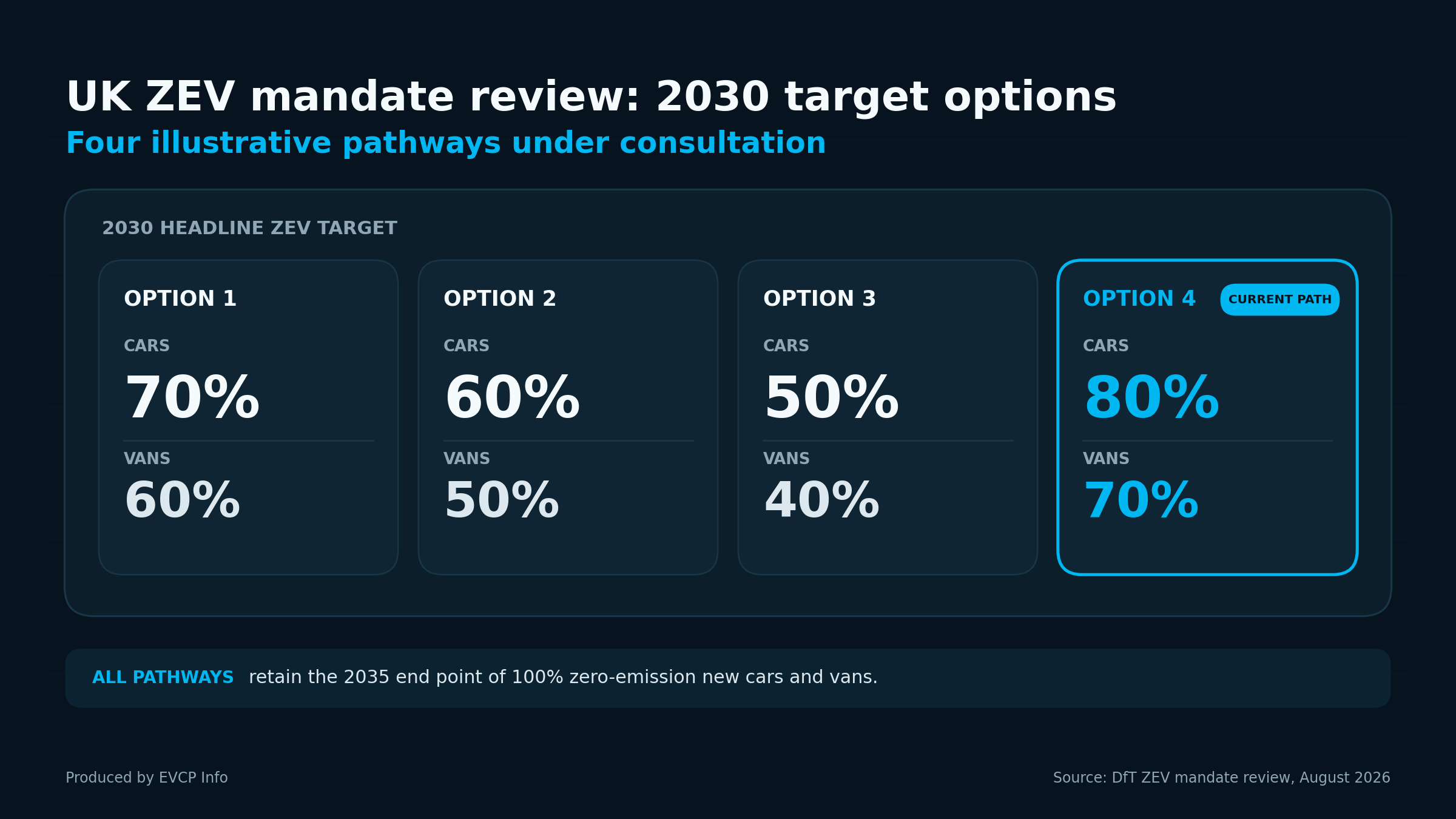
The differences begin from 2027. Under the 70% car option, the annual targets would be 36% in 2027, 46% in 2028, 58% in 2029 and 70% in 2030. The lowest pathway would instead move through 35%, 37%, 42% and 50% before accelerating to 100% by 2035.
Option 4 keeps the current headline car trajectory of 38%, 52%, 66% and 80% over the same period, but would extend key flexibilities such as borrowing, banking and CO2 conversion.
Where the car market is now
The review arrives while BEV registrations are growing strongly, but the market remains below the current headline mandate trajectory.
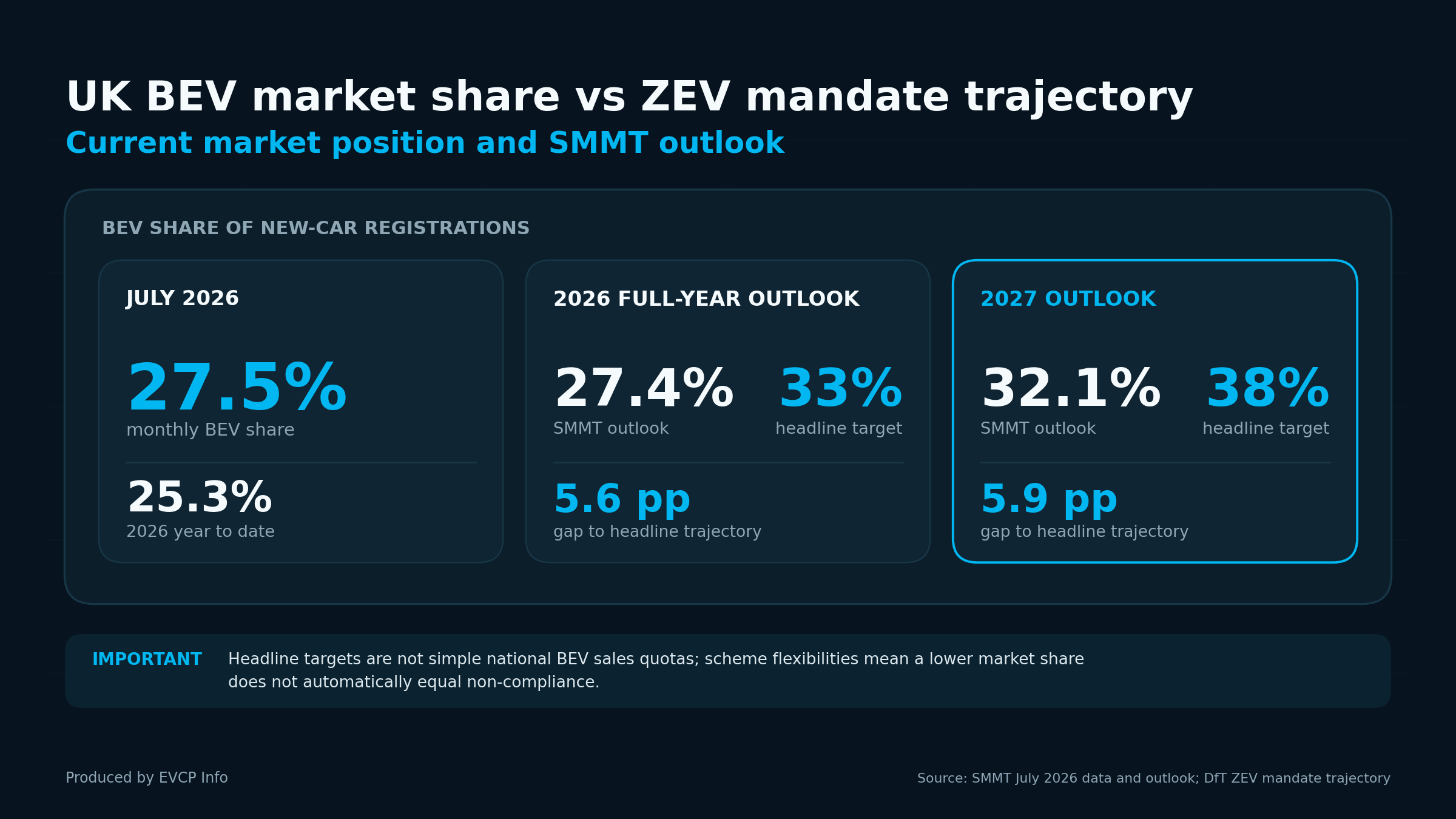
SMMT recorded 43,106 new BEVs in July, up 44.5% year on year and accounting for 27.5% of all new-car registrations. Across the first seven months of 2026, 327,683 BEVs were registered, giving them a 25.3% market share.
SMMT’s latest outlook expects BEVs to take 27.4% of a 2.18 million new-car market in 2026 and 32.1% in 2027. Those forecasts remain below the current headline mandate targets of 33% and 38%, although the gap cannot be read directly as non-compliance because of the scheme’s flexibilities.
PHEVs are also growing quickly. July registrations rose 33.6% to 23,359, giving plug-in hybrids a 14.9% share of the new-car market. That becomes more relevant if compliance flexibilities are extended and PHEVs continue to play a larger role in manufacturers’ transition strategies.
The 2030 and 2035 end points remain in place
The consultation is not proposing to abandon the government’s main end points. New cars relying solely on petrol or diesel are still due to be phased out from 2030, while all new cars and vans must be zero emission by 2035.
The review is about the annual path between now and those dates, including how much flexibility manufacturers should have when meeting the targets.
What different trajectories could mean for charging
The rate at which BEVs enter the vehicle parc feeds directly into assumptions used for public charging, home installations, workplace charging, fleet conversion and future electricity demand.
A lower 2030 trajectory would not remove the need for charging infrastructure, but it could change the pace of demand growth and the utilisation assumptions behind some investment decisions. The government says more than two million electric vehicles are already registered in the UK and that the public charging network now exceeds 120,000 charge points.
The consultation closes at 11:59pm on 23 October 2026. Any resulting changes would require future amendments to the Vehicle Emissions Trading Schemes Order.
Related articles
£70m Rapid Charging Fund pilot awarded no funding after all applicants withdrew
A £70 million government pilot intended to unlock electricity-network upgrades at motorway service areas ended without allocating any funding after all applicants withdrew, according…
Weaker ZEV targets could delay £1.56bn of home-charging investment, BEAMA warns
Weakening the UK's Zero Emission Vehicle mandate could delay up to £1.56 billion of domestic EV chargepoint sales and installations by 2034, according to…
PHEV charging behaviour becomes a policy issue as UK mandate review approaches
Plug-in hybrid charging behaviour is becoming part of the UK vehicle-policy debate, reinforcing a point that is often lost in registration statistics: owning a…