 EVCP Info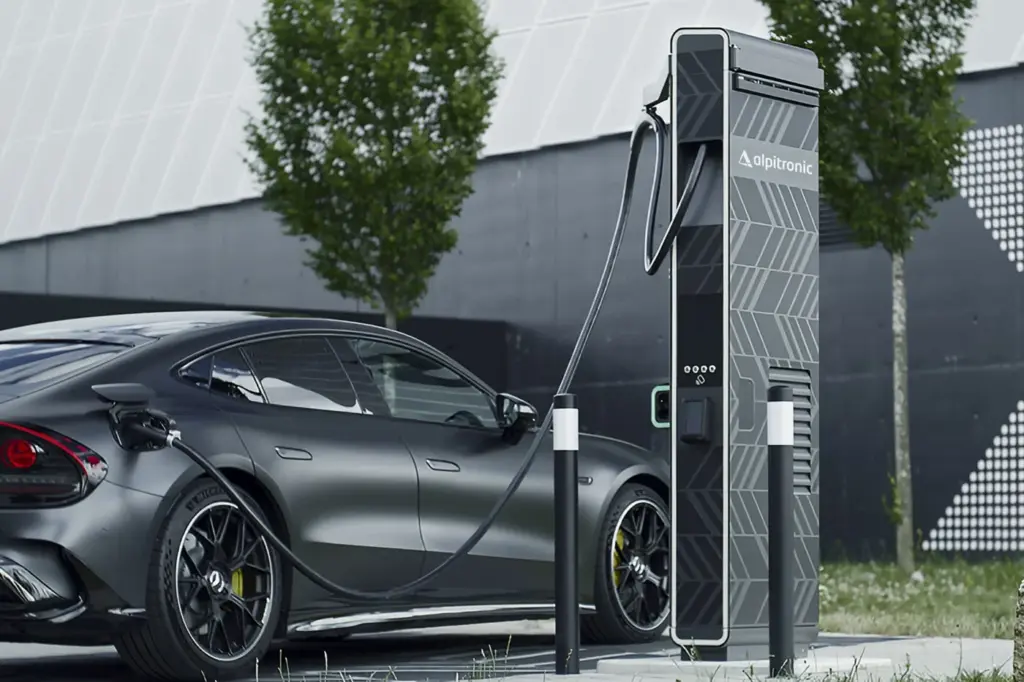
Article contents
During the ICNC26 demonstration at Tempelhof, charging power passed 500 kW and the charger display was reported at 612 kW before later showing around 620 kW. Those readings demonstrate a real session above 600 kW, but they should not be treated as a complete charging curve or evidence that the vehicle sustains 620 kW throughout a normal charge.
The demonstration is notable because the HYC1000 is not a single-purpose passenger-car charger. It is a distributed platform built around a central 1 MW power cabinet that can serve conventional CCS charging, very-high-current CCS and MCS heavy-vehicle charging through different dispenser configurations.
One 1 MW cabinet can feed up to eight charging outputs
Alpitronic specifies the HYC1000 Power Cabinet at up to 1,000 kW total output, with eight DC outputs and a 150 V to 1,000 V DC operating range. Available power can be dynamically allocated in 62.5 kW increments, allowing the installed power electronics to be shared between vehicles rather than permanently dedicating a fixed block of power to every dispenser.
The cabinet contains eight second-generation silicon-carbide power stacks rated at 125 kW and 400 A each. Alpitronic states efficiency of more than 98% for the SiC Stack GEN 2. That is a manufacturer specification, not an independently verified site-efficiency measurement.
The centralised power-pool design is more important than the 1 MW headline alone. A site with several charging positions rarely needs every connector to draw its maximum possible power at the same instant. Dynamic allocation allows the cabinet to direct more of the available capacity to the vehicles that can use it while other vehicles taper or require less power.
The 1 MW rating is the total installed DC output of the cabinet, not 1 MW simultaneously available at each of eight outlets.
Three dispenser types cover CCS and MCS use cases
Alpitronic lists three dispenser families for the HYC1000. The MCS Dispenser supports charging at up to 1,500 A and can also be configured for CCS or NACS charging up to 600 A. The EV Dispenser can carry up to two CCS or NACS connectors and supports simultaneous charging at up to 600 A.
The HP Dispenser is intended for much higher-current passenger-vehicle charging. It uses a single liquid-cooled CCS2 connector, is specified for more than 1,000 A and can operate at 800 A without derating. Its technical data shows two DC circuits from the Power Cabinet, each capable of supplying up to 600 A.
That distinction matters for the Mercedes demonstration. Mercedes-AMG says the GT 4-Door can draw more than 800 A and achieve more than 600 kW peak DC power at suitable infrastructure, which moves beyond the current level listed for a standard 600 A EV dispenser.
Mercedes-AMG independently specifies more than 600 kW peak charging
Mercedes-AMG lists the new GT 4-Door Coupe with an 800 V battery, 106 kWh net capacity and maximum DC charging power of 600 kW in its technical data. In the accompanying technical description, the manufacturer says charging current can exceed 800 A and peak charging power can exceed 600 kW when suitable infrastructure is available.
The manufacturer states a 10% to 80% charging time of 11 minutes and says 70 kWh can be added in ten minutes under its specified test conditions. Mercedes also claims that this corresponds to approximately 462 km of WLTP range added in ten minutes.
These remain manufacturer charging claims and depend on battery temperature, starting state of charge and the charging infrastructure. Mercedes itself notes that peak power varies with those conditions. The Berlin session is useful because it shows the vehicle and charger operating above 600 kW together, but it does not replace full independent charging-curve testing.
Passenger HPC and megawatt charging are starting to overlap
Historically, megawatt-class charging hardware has been discussed mainly in the context of heavy commercial vehicles. The HYC1000 shows a different direction: one distributed architecture can support MCS trucks, ordinary multi-connector CCS charging and passenger vehicles that are beginning to demand currents previously associated with much larger vehicles.
That does not mean every future passenger-car site requires a 1 MW cabinet or that a 600 kW-rated vehicle will routinely charge at 600 kW. Grid capacity, utilisation, vehicle mix, thermal limits and the shape of real charging curves still determine whether that hardware makes commercial and engineering sense at a particular site.
The more significant development is architectural. As charging-power requirements spread from conventional HPC through 600 kW-plus passenger charging to MCS, a shared central power pool gives operators a way to serve different vehicle classes from the same installed power electronics and allocate capacity according to actual demand.
Related articles
Tesla reveals European Semi with 800 kW charging and MCS 3.2
Tesla has published the first detailed European specification set for the Semi, listing approximately 550 km of range at a 40-tonne gross combination weight…
MAN eTGX demonstrates MCS charging in first UK haulier trial
John G Russell (Transport) has demonstrated Megawatt Charging System charging at its Coatbridge railhead depot near Glasgow using a series-production MAN eTGX tractor. MAN…

Revoy puts battery swapping between the tractor and trailer for US heavy-duty fleets
US company Revoy is developing a different approach to heavy-duty vehicle electrification: rather than replacing a diesel tractor with a battery-electric truck, it inserts…