 EVCP Info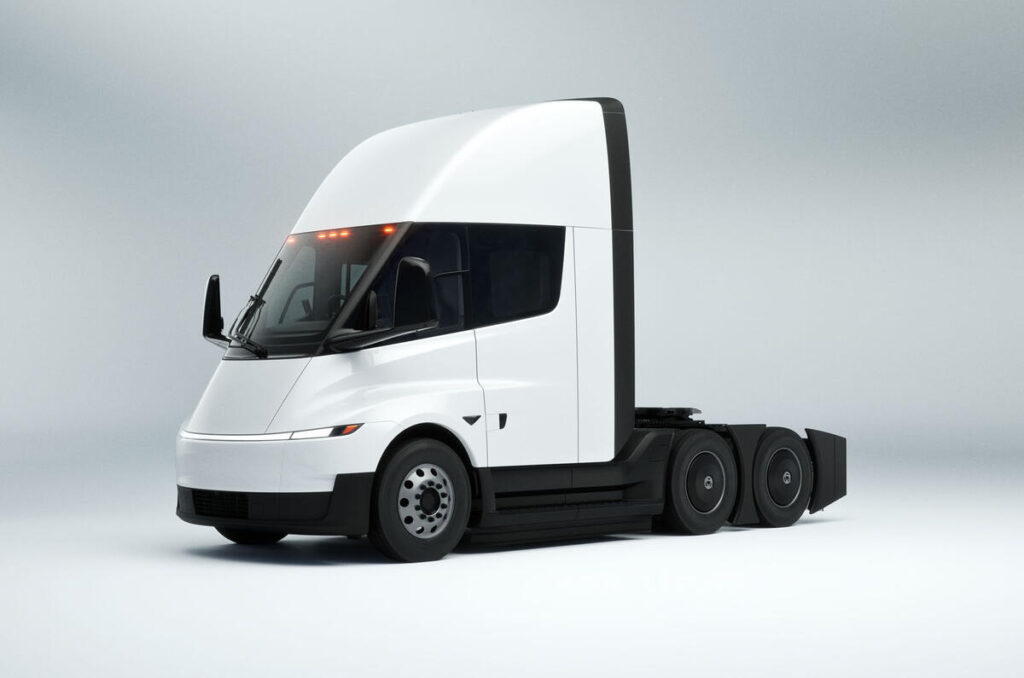
Article contents
The European Tesla page states energy consumption of 1.0 kWh/km, a curb weight of 9,100 kg, three rear-axle motors, ePTO capability up to 25 kW and recovery of up to 60% of range in 30 minutes. Tesla’s French site says European deliveries begin in 2027. These remain manufacturer specifications rather than independently verified fleet results.
Tesla now explicitly lists MCS 3.2
One uncertainty in the first reports has already been resolved by Tesla’s own European website: the charge type is listed as MCS 3.2. The question is no longer whether the European Semi uses a standards-based MCS connector, although practical interoperability with third-party MCS infrastructure will still need to be demonstrated in service.
Tesla also markets higher-power Semi charging hardware in North America, where its business charging page lists a Megacharger cabinet and post capable of up to 1.2 MW. The 800 kW European figure is considerably below the maximum output Tesla has demonstrated and marketed elsewhere. Tesla has not yet published enough European detail to establish whether 800 kW is principally a vehicle limit, a first-generation European site strategy or a combination of both.
The infrastructure requirement is still measured in megawatts
At Tesla’s stated 1.0 kWh/km consumption, a 550 km duty cycle corresponds to energy use in the order of 550 kWh. The company has not disclosed the European battery’s usable capacity or a full charging curve, so that simple multiplication should not be interpreted as a battery-capacity specification.
It does show why an 800 kW charger is not a modest infrastructure requirement. Several trucks charging together would create a multi-megawatt load even before auxiliary demand, conversion losses and site diversity are considered. Depot and hub design therefore remains dominated by grid capacity, power sharing, charging windows and the number of vehicles that must be turned around concurrently.
Europe is converging on a common heavy-duty charging problem
Tesla’s European specification arrives as production trucks from MAN and Mercedes-Benz are also moving towards MCS alongside high-power CCS. That creates a developing infrastructure spectrum from today’s 350-400 kW CCS systems through 700-800 kW transitional charging and into MCS at around 1 MW and above.
The next questions for fleet operators are practical rather than headline-based: where Tesla-compatible MCS sites will be deployed, whether third-party networks can charge the Semi without restrictions, what power the vehicle can sustain after its peak and how route planners will coordinate truck availability with charging capacity.
Related articles
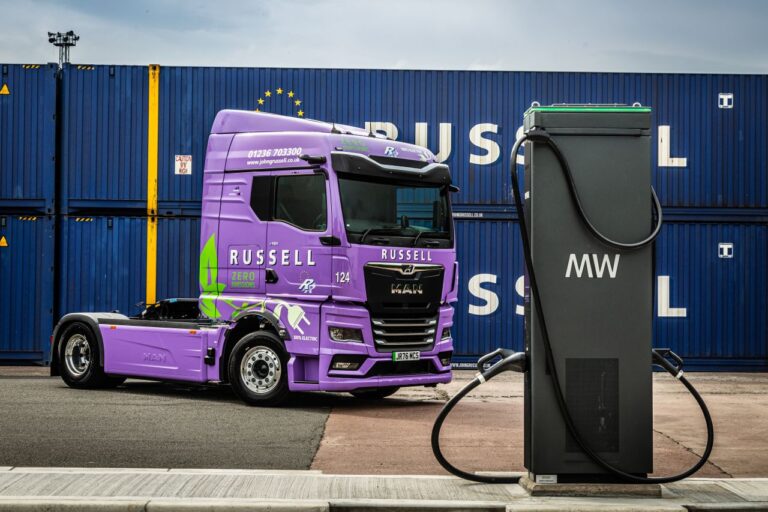
MAN eTGX demonstrates MCS charging in first UK haulier trial
John G Russell (Transport) has demonstrated Megawatt Charging System charging at its Coatbridge railhead depot near Glasgow using a series-production MAN eTGX tractor. MAN…
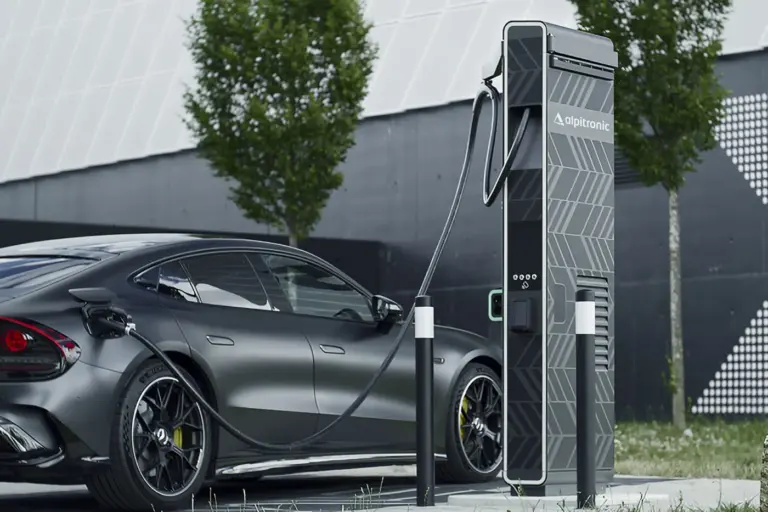
Alpitronic demonstrates 1 MW HYC1000 as AMG draws over 600 kW
Alpitronic has publicly demonstrated its HYC1000 distributed DC charging system at the intercharge network conference in Berlin, with a new Mercedes-AMG GT 4-Door Coupe…

Revoy puts battery swapping between the tractor and trailer for US heavy-duty fleets
US company Revoy is developing a different approach to heavy-duty vehicle electrification: rather than replacing a diesel tractor with a battery-electric truck, it inserts…