 EVCP Info
Article contents
The unit contains its own battery and powered axle, providing electric assistance to a conventional Class 8 tractor. Revoy’s operating model is built around exchanging the electrified unit during a journey, allowing the truck to continue while another unit is recharged.
That makes the concept relevant to charging infrastructure even though it is not a conventional public or depot charging system. It moves part of the battery, charging and energy-management requirement away from the vehicle itself and into a network of exchange locations.
A different form of truck electrification
An independent 2024 evaluation by Mechanical Vehicle Testing Services examined a 2023 Revoy unit with a 525 kWh battery. The test recorded substantial reductions in diesel fuel use while the converter provided electric propulsion assistance.
The same evaluation reported an exchange time of 3 minutes 47 seconds when the Revoy unit was changed by a company technician. Revoy’s proposition is therefore closer to swapping an electrified trailer-converter module than replacing the battery pack built into a tractor.
That distinction matters. The fleet can continue using conventional tractors and trailers, but the infrastructure provider must maintain a pool of charged converter units and suitable locations for exchanging them.
Swapping changes where the charging problem sits
Megawatt charging aims to put very high electrical power directly into the truck during a planned stop. Revoy’s approach instead allows batteries to be charged away from the active vehicle and exchanged when required.
In principle, that could create more flexibility over when individual battery units draw power from the grid and reduce the time a revenue-earning tractor has to remain connected to a charger. It does not remove the underlying energy requirement: the exchange network still needs enough grid capacity and charging equipment to replenish the battery inventory.
The economics therefore depend not only on charger power, but also on how many battery units are held at each location, how intensively they are used and how much time is available between exchanges.
The infrastructure trade-offs are different
Compared with fixed high-power truck charging, a swap-based model introduces additional physical and commercial requirements. Sites need room for vehicle circulation, exchange operations and the storage and charging of spare units. Mechanical equipment and connectors must withstand repeated handling, and the operator becomes responsible for maintaining a larger pool of battery assets.
Interoperability is another important consideration. MCS is being developed as an industry charging interface for heavy-duty vehicles, whereas a converter-and-swap system depends on the compatibility of the specific physical platform and the operator’s exchange network.
That can create a different form of dependency: instead of a fleet relying primarily on a charging network and connector standard, it may also rely on continued access to a proprietary hardware and battery ecosystem.
A useful alternative to compare with megawatt charging
Revoy should not be taken as evidence that battery swapping is becoming the dominant solution for North American trucking. The concept is still a specialised commercial model and its long-term cost, reliability and scalability will need to be demonstrated in larger deployments.
It is nevertheless useful because it challenges the assumption that every heavy-duty electrification problem will be solved by putting a larger charger next to a larger battery.
For depot designers, fleet operators and infrastructure planners, the comparison is increasingly broader: depot charging, public megawatt charging, battery or module exchange, and hybrid approaches can all shift grid demand, vehicle downtime, site footprint and asset ownership in different ways.
Related articles
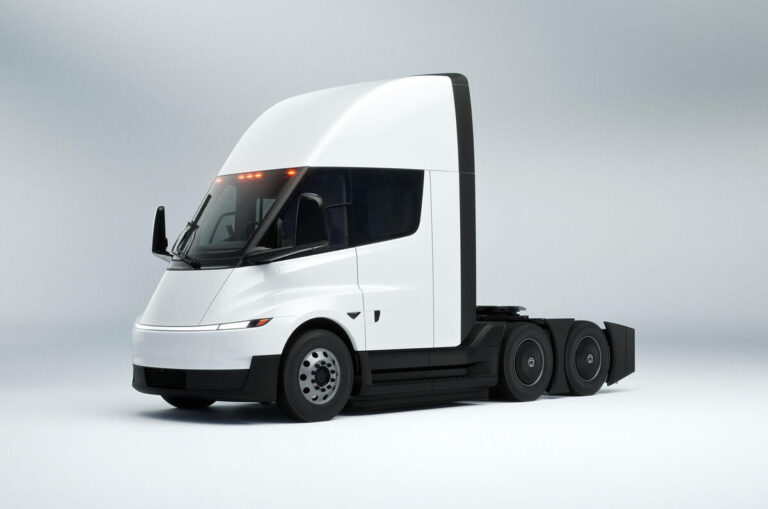
Tesla reveals European Semi with 800 kW charging and MCS 3.2
Tesla has published the first detailed European specification set for the Semi, listing approximately 550 km of range at a 40-tonne gross combination weight…
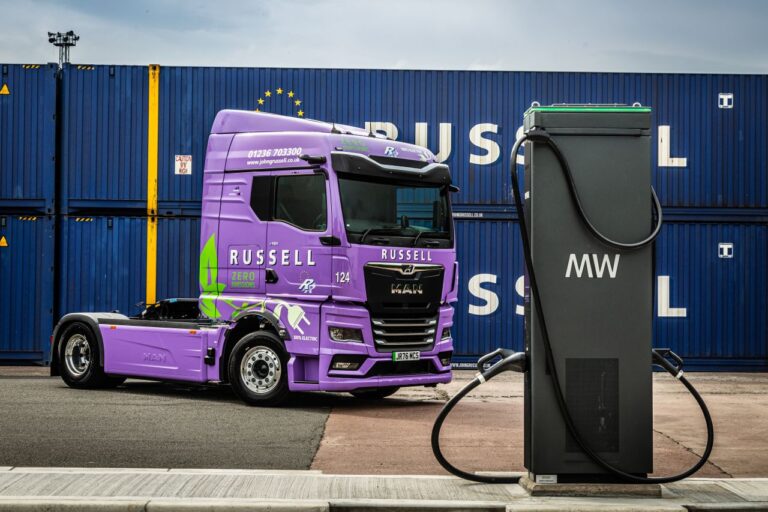
MAN eTGX demonstrates MCS charging in first UK haulier trial
John G Russell (Transport) has demonstrated Megawatt Charging System charging at its Coatbridge railhead depot near Glasgow using a series-production MAN eTGX tractor. MAN…
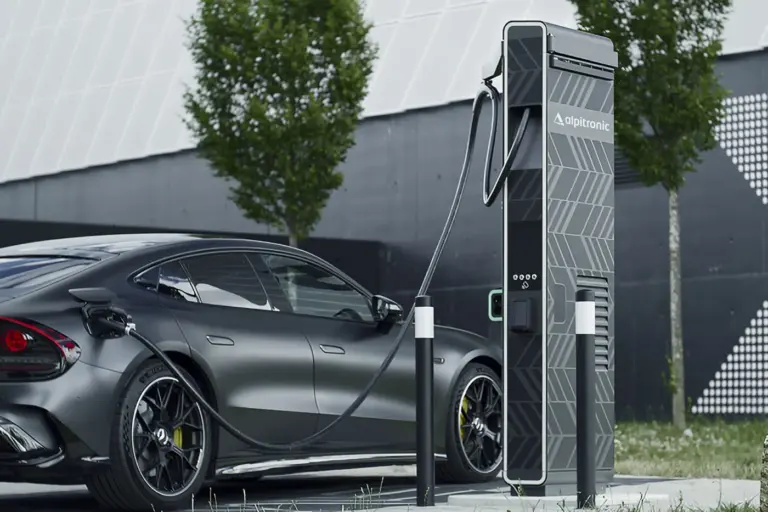
Alpitronic demonstrates 1 MW HYC1000 as AMG draws over 600 kW
Alpitronic has publicly demonstrated its HYC1000 distributed DC charging system at the intercharge network conference in Berlin, with a new Mercedes-AMG GT 4-Door Coupe…