 EVCP Info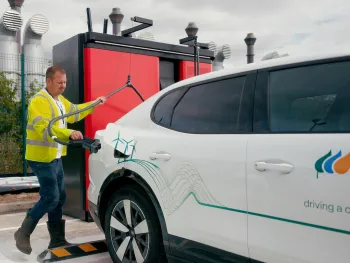
Article contents
The rollout covers Middlewich, Liverpool and Cambuslang near Glasgow. SP Energy Networks says the system is intended to support operational vehicles that need rapid turnaround at sites where conventional high-power charging can be constrained by electrical capacity, site use, lease arrangements or wider development plans.
Battery buffering separates charger peak power from grid peak power
PowerUp combines an integrated battery with high-power DC charging. The battery can accumulate energy from the site’s available electrical supply and then discharge at a higher instantaneous power when a vehicle connects.
That architecture means the grid connection does not necessarily need to supply the full vehicle-side charging peak continuously. For a fleet whose vehicles return for short breaks or restocking windows, stored energy can bridge the difference between the site’s steady available power and the much higher power required during a short charging session.
SP Energy Networks and TUAL say the operational requirement is built around dwell periods of roughly 30 minutes. The companies also say the integrated battery can support fleet continuity during a local power interruption; TUAL describes the deployed units as holding around 600 miles of stored driving energy. That resilience figure is a supplier claim and is not a published storage-capacity specification.
The architecture solves a power problem, not an energy problem
Battery buffering does not remove the underlying energy requirement. If vehicle throughput rises enough, the battery must still be replenished at an average rate that keeps pace with the energy leaving the site. A small connection paired with a large battery can support occasional high-power sessions, but it cannot sustain unlimited rapid charging if incoming energy is persistently lower than outgoing energy.
Its strongest use case is where peak charging power is much higher than average site demand: short fleet dwell windows, constrained connections, temporary or leased sites, or locations where a permanent HV reinforcement would be slow or difficult to justify.
A practical alternative to immediate grid reinforcement
The rollout is timely because recent UK charging-policy evidence has highlighted the cost, timescale and delivery risk of large grid upgrades. The conventional path is to request more capacity, reinforce the connection and then install high-power EVSE. Battery buffering introduces another option: use the existing or constrained connection to charge storage gradually, then combine that stored energy with the grid supply when a vehicle needs a short high-power session.
For fleet operators, the commercial comparison is not simply charger cost versus battery cost. It is battery-buffered charging versus the full package of connection reinforcement, civil works, programme delay, lease risk and the probability that a permanent upgrade will still be needed later as the fleet grows.
Related articles

First Bus expands smart charging from 34 to 172 outlets at Glasgow depot
First Bus has expanded Optimo Energy's charging-management system from 34 to all 172 charging outlets at its Caledonia depot in Glasgow following an initial…
5.5 km grid connection works begin for Longannet battery project
SP Energy Networks is due to begin around 5.5 km of underground cabling works to connect a new battery energy storage site at Longannet…

Anker Solarbank 4 Pro reaches UK as plug-in solar rules change
Anker SOLIX has begun UK sales activity for the Solarbank 4 Pro as Great Britain's new plug-in solar framework comes into force, bringing renewed…